

In a recent interview with The National, Economy and Transport Secretary Stephen Flynn somehow concluded that Glasgow Airport is “incredibly well served by its bus routes”, a claim many passengers and staff at the airport would find hard to agree with. More concerningly, this was also his rationale for a direct rail link being off the table during this Government’s time in office.
The gulf between the comments made by Mr Flynn and the daily reality of passengers and staff is evident to anybody who has tried to access the airport from nearby towns and villages. Arriving International visitors, often travelling with bags or young children, are not greeted by a seamless, integrated multi-modal transport system seen across Europe, but instead by “premium” bus services charging £11 single fares – not to mention that during frequent diversions in the city centre, diversion information is incredibly difficult to find.
If we strip away the 500 bus into the city, passengers travelling to Paisley Gilmour Street for the train are greeted with an infrequent bus service which lacks baggage storage facilities and integrated ticketing with the trains. Citylink and Ember services run infrequently, only Flixbus’ route to Aberdeen passes the frequency and simplicity test.
Once the above is considered, it becomes easy to see why the most recent Civil Aviation Authority (CAA) Departing Passenger Survey covering Glasgow Airport lists its public transport modal share at 11.5%, less than Aberdeen and Inverness, and substantially below Edinburgh. Mr Flynn’s comments seem to ignore reality, and instead suggest it’s better to try and pass off the current service as “incredible” to avoid committing to a comprehensive national infrastructure review.
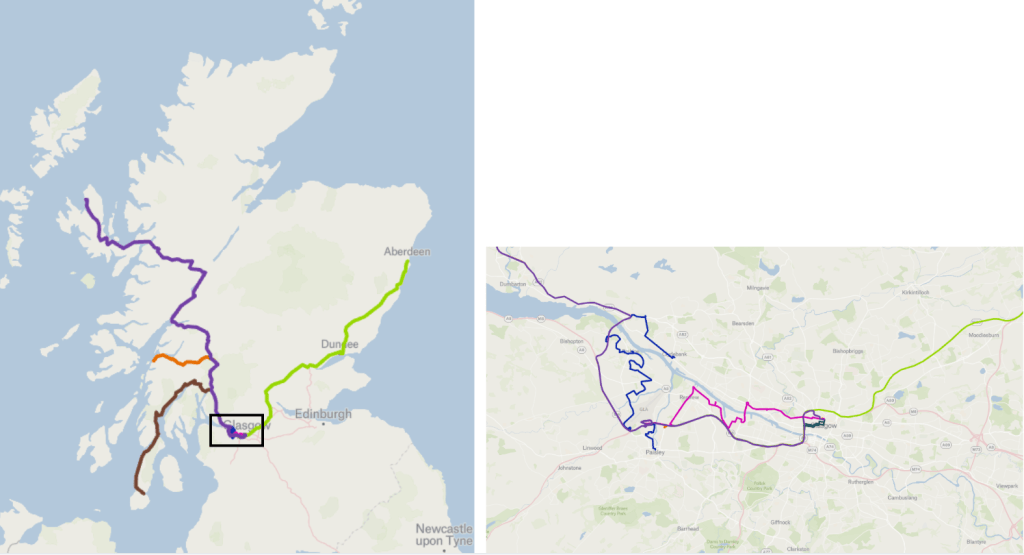
Current Bus Network Gaps
Based on the above maps, the gaps in the existing bus services at Glasgow Airport are clear, areas such as Inverclyde, Ayrshire, Glasgow Southside, Northern Glasgow and the East end of Glasgow are all currently unserved by buses from the cities airport.
These areas not only generate passengers for the airport, but are key employment areas for the airport itself, and the airlines, retailers, ground handlers and security companies that all operate within the airports ecosystem. Affordable direct transport to these areas would not just serve passengers, but increase access to employment for people living in these areas – places such as Inverclyde which has the highest rate of unemployment in the Glasgow City Region should absolutely be directly connected to the airport to increase access to employment.
AGS Airports Is Not Blame Free
For a number of years, Glasgow Airport and its owners (AGS Airports) appear to have viewed public transport access as something that removes revenue from its car parks, rather than something that improves passenger satisfaction, makes it more accessible for its catchment areas and a barrier remover for staff who want to work at the airport.
Unlike Edinburgh Airport which published a detailed “Surface Access Strategy” in 2025, Glasgow Airport has not released one since 2009 – at that point AGS was still 4 years away from being set-up, and Arriva was still operating local bus services.
Things have improved slightly over the last few years, Ember has launched services to Oban and Fort William, and Flixbus has launched a service to Stirling, Perth, Dundee and Aberdeen. These are welcome additions, but fail to cater to the majority of the airport’s passengers who live in the central belt of Scotland.
For me, there are a number of steps AGS should be taking to improve its surface access;
- Incentivise new bus routes, or work with operators to tweak existing bus routes to serve the airport.
- Upgrade terminal signage and navigation signs, make bus stances easier to find while providing live information boards at each one.
- Working with regional partners such as SPT, local councils, and organisations such as the SEC to demand strategic infrastructure investment in Glasgow and the city region.
Scottish Government Aviation Strategy – Does it Work?
Transport Scotland set out its “Aviation Statement and Key Priorities” in 2024, and Glasgow Chamber of Commerce wasted no time in accusing the agency of ignoring its “airport-neutral” stance in favour of Edinburgh Airport.
I don’t want to focus on the routes element of this, but rather, I want to focus on why the Scottish Government is dedicating so much of its aviation policy on supporting Edinburgh Airport’s push for US Pre-Clearance, an issue it ultimately has no control over, to benefit 6% of the airports passenger numbers, while seemingly overlooking a better bus network for Glasgow Airport and the surrounding area, something it has full control over. To be clear, I’m not saying the Pre-Clearance idea shouldn’t be explored, but it should not be the sole focus of Transport Scotland when it comes to aviation in the central belt.
The same document states that Transport Scotland aims to see “Aviation emissions reduced compared to 2019 levels”. That claim is obviously talking about aircraft emissions, when in actuality, the Scottish Government should be supporting all of Scotland’s airports to reduce private car usage and increase public transport usage – a direct contradiction to the flat refusal of a rail link.
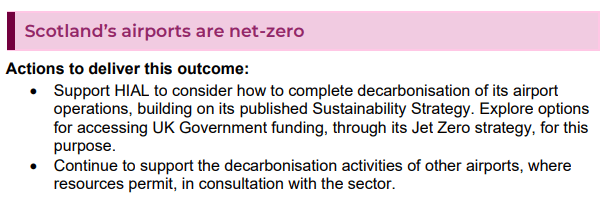
Page 14 of the same document even states that Transport Scotland will continue to support the reduction of carbon emissions at airports across the country “where resources permit.”
Under the Transport (Scotland) Act 2019, local transport authorities (in the case of Glasgow that would be SPT) have had the legal powers to establish their own bus companies since June 2022, and full power of bus franchising since late 2023.
The issue isn’t pushing for US Pre-clearance, its the current approach of one airports needs over another – if the Scottish Government was serious in its desire to decrease private car usage then the Clyde Metro scheme wouldn’t still be in its consultation stage, but rather, immediate changes to bus franchising and operations would be prioritised.
Again, AGS is not blame free here, sitting back and not saying anything publicly about a lack of support from Transport Scotland has not been a beneficial strategy so far, and nothing will change about its lack of success.
What Needs to Change?
It’s easy for me to sit behind a computer screen and keyboard and say the current network is not good enough and needs to change, but what are the easiest and most straightforward changes that need to occur?
Upgrade the Paisley Gilmour Street Bus Link
The current 757 service operates every 30 minutes (every 60 on Sunday), and currently routes through Shortroods before reaching Paisley.
Furthermore, the current fleet of vehicles used by McGills are not designed for airport runs due to their lack of luggage storage areas onboard. The lack of integrated ticketing between McGills and ScotRail is also an issue, passengers require two tickets, and is actually a step back from what was required in 2019.
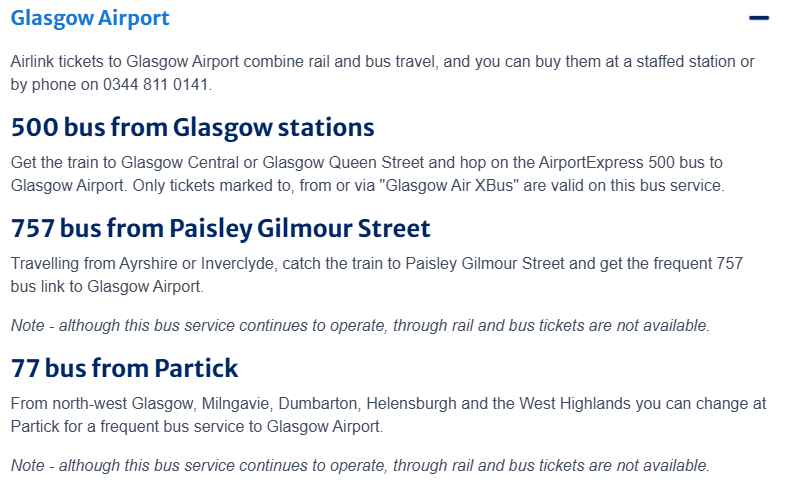
ScotRail promotes the 757 bus service, and announces it on approach to Paisley Gilmour Street station, but through tickets cannot be purchased. As ScotRail is now owned by the Scottish Government, its about time they work with the airport and McGills buses to allow through tickets on this service again.
Outside of this, a dedicated Paisley-Glasgow Airport bus service should be established as a short term solution to the airport’s surface access problems. A well run direct bus service running from the first to last trains with integrated ticketing, clear signposting, dedicated luggage racks and flight/train information screens would be a major improvement over what is there now, and would improve surface access for travellers from Ayrshire and Inverclyde.
A longer term solution would be working with McGills, First Bus, Stagecoach or any other bus/coach operator to resume direct links to these areas, provided that any service was operated with suitable vehicles, electric where possible. Although McGill’s currently operates its ClydeFlyer services from Inverclyde to Glasgow which bypass the airport, these vehicles do not currently provide luggage racks for baggage, which are not ideal for airport runs, but could be an interim solution.
Can Current Bus Routes Through Paisley be Extended to the Airport?
Anybody who knows Paisley can confirm that the town is full of buses, some of which terminate in the town, and some of which run through to other places.
McGills currently operates the majority of services, and already serves the airport. AGS should ideally work with McGills to extend some routes to the airport, on the provision that these would be well marketed and supported in their initial phases of operation.
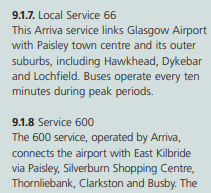
The 2009 Surface Access Strategy outlines some previous services that used to run under Arriva, who were purchased by McGills, these would be ideal starting points for this suggestion.
Glasgow Superloop?
Under the powers granted under the Transport (Scotland) Act 2019, Glasgow should be taking inspiration from London and setting up its own Superloop bus network.
Superloop is described by Transport for London as “a network of 12 express bus routes which improves connections and journey times between key outer London town centres and transport hubs.”
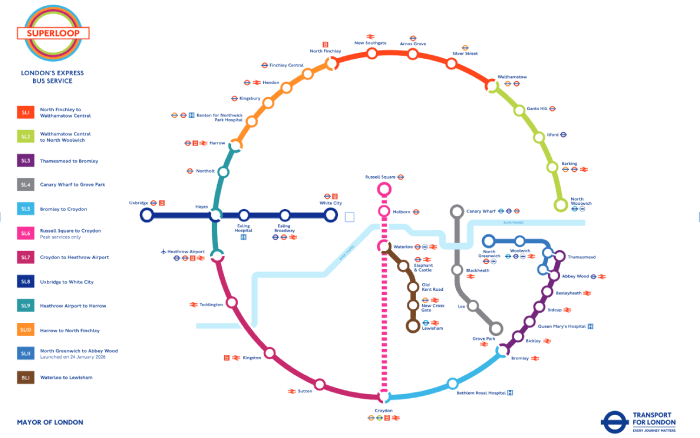
Superloop is so effective because it avoids Central London congestion. That sounds ideal for Glasgow, imagine a network of limited stop express buses around the outskirts of Glasgow that avoid the M8.
Glasgow Airport as a key source of passengers and tourists should be pushing for multi-level Government co-operation for a similar network in Glasgow.
A dedicated Superloop network in Glasgow would not just benefit the airport, but rather address a wider issue within the Glasgow area, high fares and unreliable services provided by private sector operators. A publicly run service in SPT branding supported by major stakeholders in the cities economy would be a welcome first step in establishing the full Clyde Metro service.
Partick Interchange
Paisley Gilmour Street is not the only railway station served by bus from Glasgow Airport, Partick in the West End of the city is served by First Glasgow’s 77 service, with two buses per hour and a journey time of 50 minutes (for a journey less than 10 miles).
Despite the slower than desired journey length by bus, the 77 services have a dedicated small luggage rack and Partick station has step free access to both platforms, yet little is advertised of the interchange available. No announcements are made on trains arriving into Partick, and at the station no clear signage points you towards this service.
Improving the bus connection to Partick on the 77, potentially incorporating it into the proposed Superloop network and working with ScotRail and SPT to promote this interchange would make access to one of the busiest rail corridors in Scotland easier and more appealing to passengers, and the West End of the city is home to a number of Universities, with the area being a hot spot for International Students in the city, the exact people this service enhancement would benefit the most.
Prague – The Perfect Case Study
If Glasgow is looking for a case study in Europe for what a truly integrated public transport system looks like, then I suggest sending a team to Prague and learning from them.

Passengers travelling anywhere within the map above can use the same ticket on any bus, tram, trolleybus, metro or ferry, as well as all local and regional trains for the entire length of their ticket, regardless of time of day.
For context, from Karlovy Vary in Zone 13 to Světlá nad Sázavou on the other side of Prague in Zone 12, is 230 kilometers, the equivalent of Glasgow Central to Lancaster.
The PID app also makes selecting the right ticket easy through an integrated journey planner that allows you to toggle whatever modes of transport you want, select a minimum transfer time, and buy the relevant ticket all in the same process. For those who want the most flexibility, you can choose from a set list of tickets. For a 24 hour, all zone ticket, the cost is 288 CZK, 78 pence cheaper than a single ticket for the 500 Express Bus service in Glasgow.
The really irritating thing? SPT already has a near perfect equivalent, the Zonecard. The problem is its high cost of entry and lack of publicity, a family of four coming to Glasgow for a weekend (Fri-Mon) would be forced to pay £326.40 (2 adults and 2 children) just for the luxury of having unlimited public transport, yet in Edinburgh the same family would only need to pay £52 for unlimited bus and tram use on Lothian Buses.
If the Scottish Government and Destination Glasgow were serious about improving public transport usage, and integrating Glasgow Airport into this regional scheme, it’s about time public transport is taken seriously in the West Coast of Scotland, and reforms are no longer used to score political points.
Passing off a single, premium bus service from Glasgow to the city centre as “incredible” surface access does a disservice to the passengers, airport workers and regional communities that depend on Glasgow Airport. Delivering real progress requires moving beyond political soundbites and passive management. By making improvements to existing services, while leveraging city wide bus franchising powers already available under devolved legislation, expanding bus services in and around Glasgow Airport, both Holyrood and AGS Airports can build a multi-modal transport system that serves the entire West of Scotland effectively.
If the Scottish Government and AGS Airports are both serious about improving surface access, it’s time for more support from the former, and for the latter to become far more publicly vocal about how they can be supported in doing so.
If Glasgow really wants to have a serious public transport system, they could learn a lot from other UK cities such as London or Manchester, or for possibly the best example in Europe send a team to Prague and learn from Pražská integrovaná doprava. If other UK and European cities can do it, then so can Glasgow.
Discover more from George Nugent Travels
Subscribe to get the latest posts sent to your email.
